RTC (Real-Time Chunking)#
RTC (Real-Time Chunking) constrains the current denoising process with a known action prefix from previous predictions. This reduces inconsistencies between adjacent action chunks and improves trajectory continuity under asynchronous execution.
Training-time RTC#
Method#
Training-time RTC applies a shared prefix-conditioning principle to both training and inference:
During training, the model is optimized under known-prefix constraints for consistent future-action prediction.
During inference, prefix locking is applied to preserve cross-chunk continuity.
In this document, Training-time RTC means the combined setup of prefix-conditioned training and prefix-mode inference.
Configuration#
Training-side configuration#
The placement of rtc_training_config depends on the model architecture:
GR00T (FlowMatchingHead) — add under model.vla_head:
model = dict(
    vla_head=dict(
        rtc_training_config=dict(
            enabled=True,
            max_delay=7,
            distribution='exponential',  # 'exponential' (recommended) or 'uniform'
        )))
PI0 (PI0FlowMatching) — add directly under model:
model = dict(
    type='PI0FlowMatching',
    rtc_training_config=dict(
        enabled=True,
        max_delay=7,
        distribution='exponential',  # 'exponential' (recommended) or 'uniform'
    ))
Note: PI0.5 (
PI05FlowMatching) does not support training-time RTC.
Mechanism: for each batch element, sample a delay d ∈ [0, max_delay). The first d action steps are set to clean time (known no-noise states) and masked out from the loss.
Inference-side configuration#
Use prefix mode in rtc_config and keep async_execution=True:
inference = dict(
    type='AlohaRTCInferenceRunner',
    async_execution=True,
    execute_horizon=10,
    rtc_config=dict(
        enabled=True,
        method='prefix',
        prefix_len=5,
    ))
Complete example#
The following example uses GR00T deployed on ALOHA:
_base_ = './gr00t/gr00t_eagle_3b_aloha_full_finetune.py'

# Training: enable RTC prefix conditioning
model = dict(
    vla_head=dict(
        rtc_training_config=dict(
            enabled=True,
            max_delay=7,
            distribution='exponential',
        )))

# Optional continued finetuning from a pretrained checkpoint
runner = dict(max_epochs=1)

# Inference: use prefix mode with async execution enabled
inference = dict(
    type='AlohaRTCInferenceRunner',
    async_execution=True,
    execute_horizon=10,
    rtc_config=dict(
        enabled=True,
        method='prefix',
        prefix_len=5,
    ))
Test-time RTC#
Method#
Test-time RTC is an inference-only guidance method:
Training remains unchanged.
During inference, guidance steers the denoising trajectory toward prefix-consistent outputs.
Use this method when training was performed without RTC prefix conditioning.
In this document, Test-time RTC means the inference-only guidance setup.
Configuration#
Set guidance mode in rtc_config (with async_execution=True):
inference = dict(
    type='AlohaRTCInferenceRunner',
    async_execution=True,
    execute_horizon=10,
    rtc_config=dict(
        enabled=True,
        method='guidance',
        prefix_len=5,
        decay_end=10,
        schedule='exp',
        max_guidance_weight=5.0,
        use_vjp=False,
    ))
Difference from Training-time RTC#
Training-time RTC: modifies training and uses
method='prefix'at inference.Test-time RTC: keeps training unchanged and uses
method='guidance'at inference.In a single inference pass,
prefixandguidanceare typically used as alternative routes.
Testing#
The repository provides scripts/test_rtc.py to test and visualize RTC inference behavior. It:
loads model weights from config + checkpoint,
fetches one batch from the training dataset,
uses ground-truth actions to simulate
prev_actions(the prefix source in this test),runs selected RTC modes (configurable via
--modes),outputs per-dimension denoising plots and comparison plots.
Available modes: no_rtc, prefix, guidance, guidance_vjp. All modes run by default.
Using GT as the prefix source keeps the prefix condition controlled and makes differences between RTC methods easier to compare.
Example commands:
# GR00T / PI0 — run all modes (default)
python scripts/test_rtc.py \
    --config configs/gr00t/gr00t_eagle_3b_aloha_full_finetune.py \
    --checkpoint /path/to/checkpoint.pt \
    --prefix_len 5 \
    --output_dir work_dirs/rtc_test

# PI0.5 — skip prefix mode (unsupported)
python scripts/test_rtc.py \
    --config configs/pi05/pi05_paligemma_aloha_full_finetune.py \
    --checkpoint /path/to/checkpoint.pt \
    --prefix_len 5 \
    --modes no_rtc guidance guidance_vjp
Test visualization#
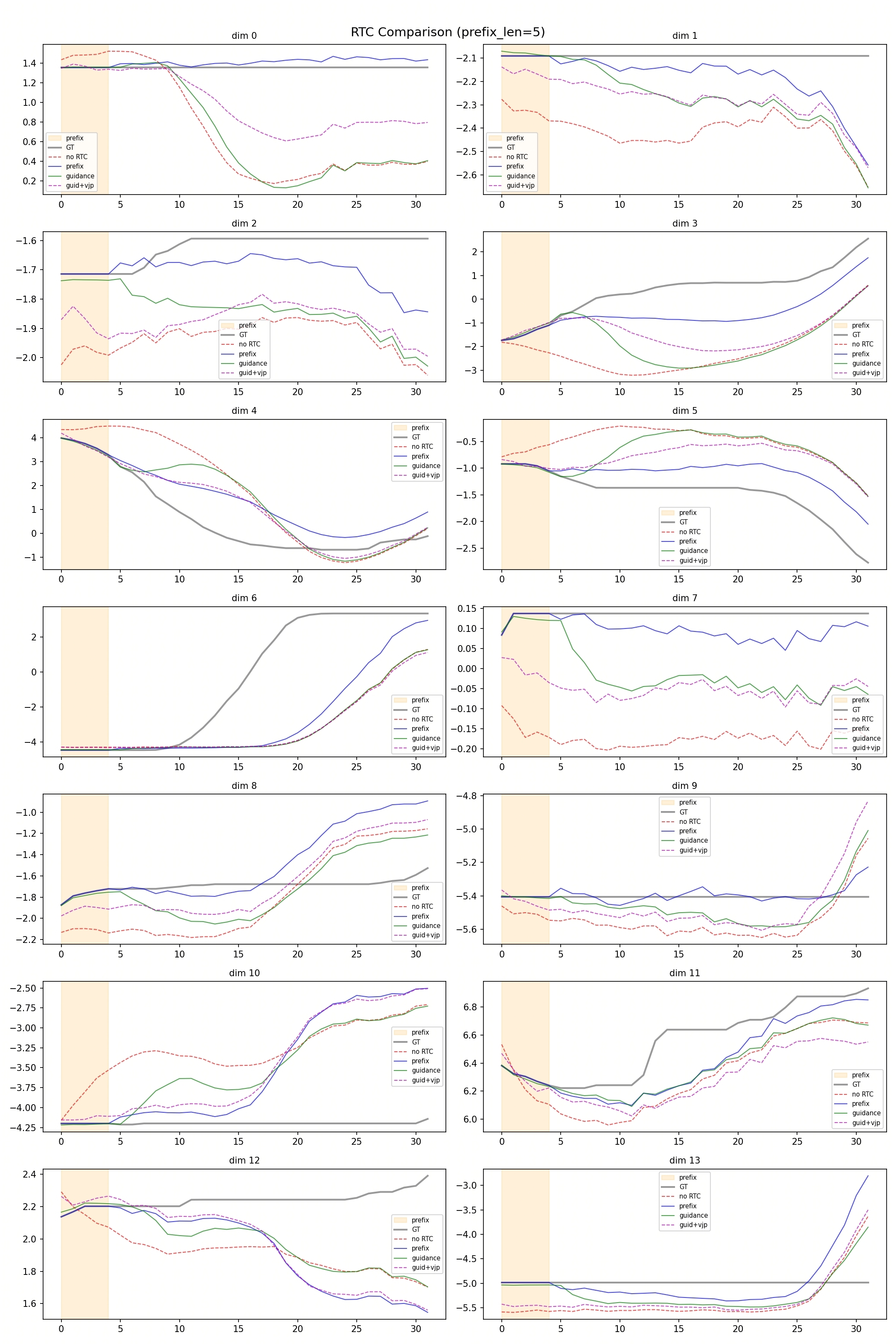
This figure compares trajectories from no RTC, prefix, guidance, and guidance+vjp.
The shaded prefix window marks the known-action region used during RTC inference.
Qualitative interpretation:
In this figure, GT serves both as the reference trajectory and as the simulated prefix source for RTC.
The
no RTCcurve serves as the unconstrained baseline.prefixmode (training-time RTC path) often follows a different trajectory fromno RTCafter the prefix window, indicating stronger prefix-conditioned continuation.guidancemode (test-time RTC path, includingguidanceandguidance+vjp) often stays closer to theno RTCbaseline in later steps, while mainly improving the transition near the prefix-to-generation boundary.
This figure is intended as a qualitative reference for comparing post-prefix trajectory behavior between training-time RTC and test-time RTC.
Supported models#
Model |
Training-time RTC |
Test-time RTC |
|---|---|---|
FlowMatchingHead (GR00T) |
✅ |
✅ |
PI0FlowMatching (PI0) |
✅ |
✅ |
PI05FlowMatching (PI0.5) |
❌ |
✅ |
Note: PI0.5 does not support training-time RTC — its architecture cannot inject per-position timesteps without model modifications.